
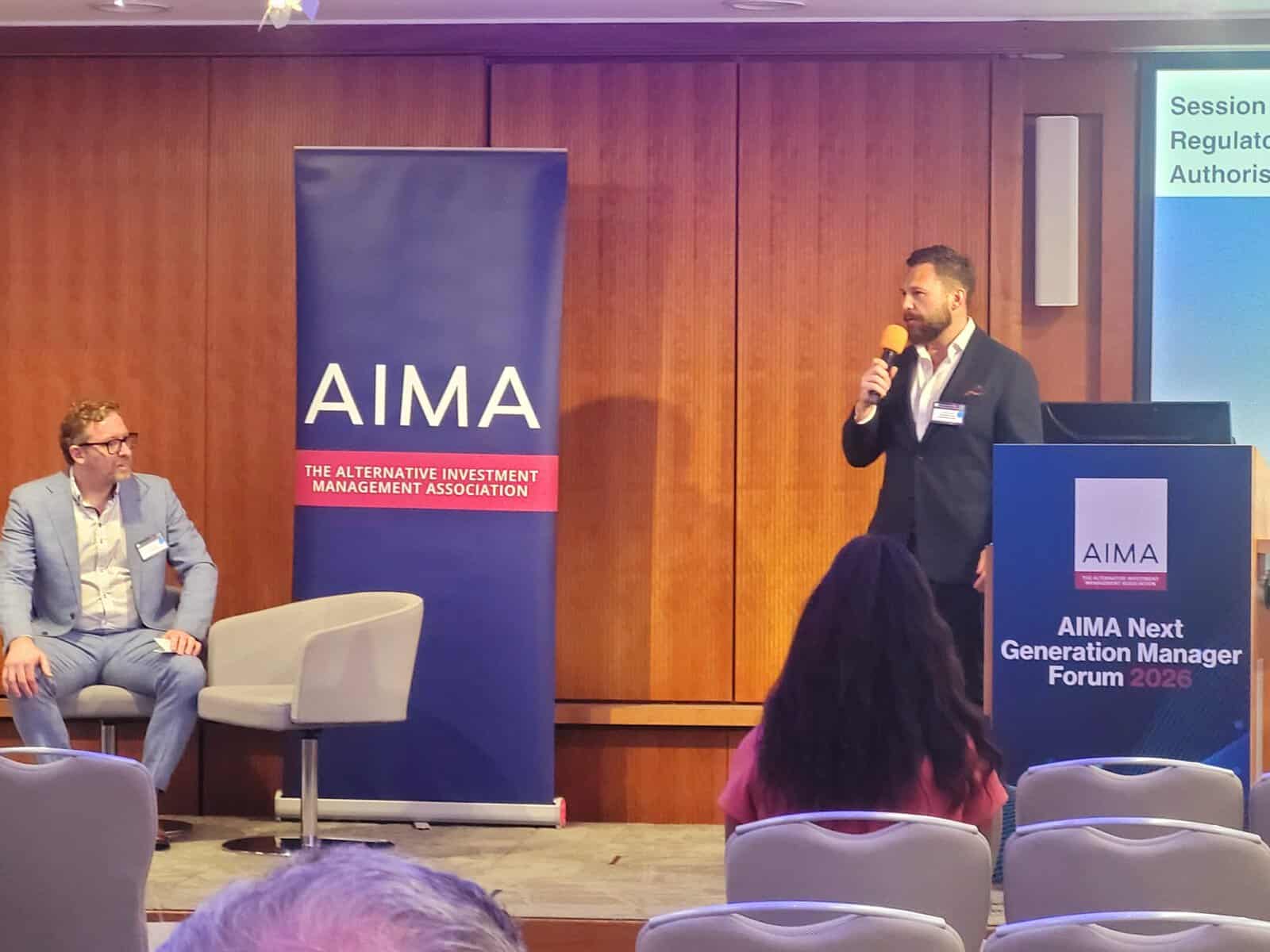
At the AIMA Next Generation Manager Forum in London on 19 May 2026, Ant Bennett and Matt Raver co‑hosted a session titled ‘Entering the Market: Regulatory Hosting and the FCA Authorisation Journey’. Here are the key points they shared.
There is a quiet distortion in the regulatory compliance market. Too many hedge fund managers are being encouraged to view regulatory hosting and FCA authorisation as decisions about speed, cost and process. They are not.
The real question is what structure gives the business the highest probability of institutional success over the next three to five years. That is the conversation sophisticated allocators, prime brokerage consulting desks and ODD teams expect serious managers to be having.
At its weakest, hosting is sold as a shortcut. At its best, it is an institutional infrastructure decision, a governance decision, an allocator perception decision and, often, a strategic lifecycle decision.
The authorisation conversation has become too simplified. Managers hear claims about three-month approvals, lighter applications, cheaper upfront fees and better technology workflows. These may sound appealing when a launch is gaining momentum, but they can leave out harder questions.
Can the manager pass investor ODD and meet applicable compliance and regulatory requirements? Is the governance framework mature enough? Are surveillance, market abuse monitoring, e-comms, best execution, regulatory reporting and operational resilience properly embedded into day-to-day operations? Has the manager understood regulatory risks, SMCR accountability and the ongoing burden of being authorised, can they clearly articulate these concepts to an FCA case handler?
Getting an FCA licence is not a quick transaction. It is closer to a marriage. There is permanence, responsibility and cost. Regulatory hosting is more like a long engagement. It gives a manager structure, a safety net and the space to prove the business before taking on the full weight of direct authorisation.
Sophisticated managers were never choosing hosting simply because it was quicker. Speed is a byproduct. The deeper value is certainty, institutionalisation, access to an ecosystem, allocator credibility, operational maturity and allowing investment managers to focus on alpha generation and capital formation.
A mature hosting platform gives an emerging manager something difficult to replicate at launch. From day one, the manager inherits governance, surveillance, market abuse monitoring, best execution, prudential oversight, regulatory capital support, e-comms surveillance, regulatory reporting and experienced compliance judgement.
Certainty is underappreciated in this debate. Emerging managers often become urgent once capital starts to appear. They may be negotiating term sheets, planning hires or discovering that serious SMA interest has arrived before the commingled fund is ready. Hosting can provide a high probability of being operational within a known timeframe. That is execution certainty.
Allocator perception is the least openly discussed part of the market. Allocators have views on hosting structures. Some prefer hosted firms over newly authorised start-ups. Some maintain pre-approved host lists. Prime brokers also have preferences, particularly for SMA structures, because they care about capital reuse, margin efficiency and reducing operational risk.
When a manager chooses a host, they are not simply choosing a compliance provider. They are choosing part of their institutional access, part of their ODD profile and part of how the market perceives their robustness. A cheaper or less mature host can defeat the purpose of hosting altogether.
The same logic applies to FCA authorisation. There are firms for whom moving onto their own licence is the right step, but it has to be the right step at the right time. The FCA remains subject to statutory timeframes of up to six months to determine a complete application and up to 12 months for an incomplete application. In practice, however, processing times appear to have reduced this year, and a well-prepared complete application may now be processed in around three to four months. That should not be mistaken for a shortcut. Firms need to be ‘ready, willing and organised’ with key progress made on hiring, corporate structure, product structure, governance and compliance infrastructure in advance. In our experience, for a start-up, the preparatory work takes at least two months in advance of submitting the application materials. That means that firms following this path must be aware of the upfront investment to achieve the determined “complete application” phase, beyond paying a FCA application fee. Other considerations apply and you should consult with an expert in our team on the true costs involved. A quick time to market is of course very achievable.
However, outsourcing the application work and compliance retainer mandate alone does not remove accountability. Even where tasks are performed by a managed service or compliance consultant, the authorised firm retains the principal regulatory risk. That is why the quality of the partner matters. SMCR training, and the role of outsourced COO’s in SMF16 and SMF17 roles will provide partial relief but will not always pass the rigour of the allocator’s ODD.
The industry has become too binary. Some firms oversell hosting as price-led rather than value-led. Others oversell authorisation by focusing on how quick, light or cheap it can be. Both approaches risk encouraging managers into structures that do not match their stage of development or operational readiness.
The better question is not which product is cheapest.
It is what gives the manager the highest probability of institutional success. For some, that means launching through a regulatory host. For others, it means applying for an FCA licence. For many, the answer will change over time.
Regulatory hosting is not fundamentally a shortcut. The best hedge fund founders and COOs are not buying speed. They are buying certainty, maturity, infrastructure, expertise, allocator confidence and the strongest possible foundation for long-term institutional success.
Capricorn Group and the RQC team support this lifecycle with hosting and compliance solutions designed for firms at different stages of development. This includes regulatory hosting platforms for investment managers, investment advisers, deal arrangers and marketers of funds and investment services, enabling firms to operate within an established, institutional-grade framework from day one.
Beyond hosting, RQC provides end-to-end regulatory support, from FCA authorisations through to ongoing compliance oversight, helping firms build and maintain robust governance and control environments. This is complemented by our CPD-certified e-Learning courses, ensuring that teams remain up to date with evolving regulatory expectations and internal compliance standards.
By combining infrastructure, regulatory expertise and practical implementation, RQC Group enables firms to focus on developing their investment business with confidence, knowing that their operational and compliance framework is aligned with institutional expectations.
If you are evaluating your regulatory options, we would welcome a conversation on how we can support your next stage of growth, with a clear north star of providing you with the highest chance of institutional success.
Please click here to speak to our team.
This article is co-authored by:

Ant Bennett, Group Head of Business Development – Capricorn Fund Managers
Anthony is Group Head of Business Development at Capricorn Fund Managers and is responsible for leading strategic, group-wide business development, strengthening institutional engagement internationally, and supporting the continued scaling and professionalisation of the firm’s alternatives platform. He has over 20 years’ experience across prime brokerage, platform solutions and alternative asset management, supporting investment managers to launch, grow and institutionalise their businesses.

Matt Raver, Managing Director – RQC Group
Matthew is a Managing Director at RQC Group with over 27 years’ experience in regulatory compliance. Widely regarded as a “consultants’ consultant,” he specialises in complex regulatory issues and transformation initiatives, and also sits on the Regulatory Hosting Committee overseeing hosted investment managers and appointed representatives.